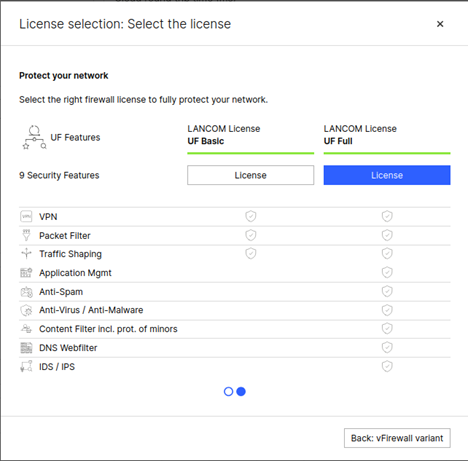
Description:
SPLA is available for vFirewalls running at least LCOS FX 11.1RU2 or LCOS FX-I 1.2RU1. This article provides guidance for picking the correct license and explains a few special scenarios that do not apply to hardware appliances.
Requirements:
- LANCOM R&S®Unified vFirewall
- LCOS FX as of version 11.1RU2
- LCOS FX-I as of version 1.2RU1
- Aktive SPLA for your LMC project
To use SPLA you first need to enable SPLA on your LMC project. If that has not happened yet, please get in touch with your LANCOM sales representative.
How vFirewall licenses work:
LANCOM vFirewalls are different from hardware appliances in that the user is able to assign as much or as little hardware resources to the appliance as he needs.
The license for a vFirewall needs to be chosen to fit the resources available to the underlying VM.
The following table shows how much resources a VM may offer for a given vFirewall size.
Ressource | vFirewall- S | vFirewall- M | vFirewall- L | vFirewall- XL |
max CPU Cores | 1 | 2 | 4 | 16 |
max RAM [GB] | 4 | 8 | 16 | 64 |
max Users | 20 | 100 | 200 | 500 |
max VLANs | 16 | 32 | 64 | 256 |
You can choose a licence that allows more resources than your VM at any time.
- If your VM exceeds one of the CPU or RAM limits, you need to choose a bigger license or restrict your VM.
- The users and VLANs limits are just guidance values to help you choose an appropriate resource layout.
Displaying the firewall in the device table:
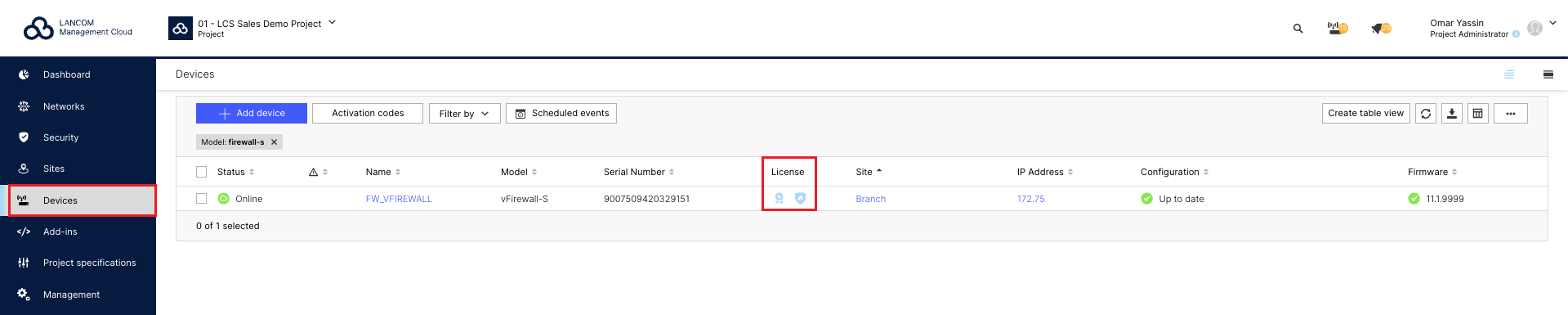
Click on one of the two icons in the Licence column to open the dialogue box with the licence information for the respective device (see next section).
Choose license:
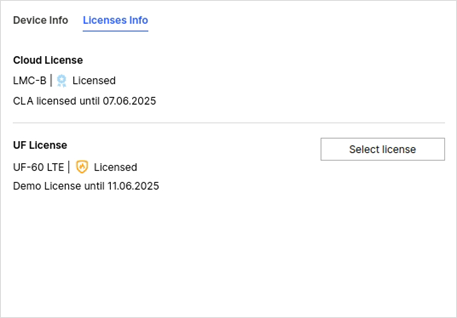
1. In the Licences Info tab, click the Select licence button.
2. You will now be prompted to select the desired vFirewall licence size.
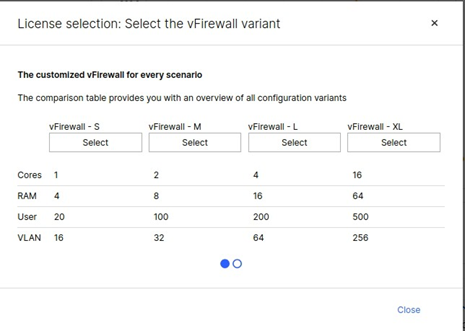
3. To select a licence size, click the Select button in the corresponding column.
Choosing the right license - A positive example:
In this positive example, the specifications of the VM are as follows:
- 4 CPU Cores
- 8 GB RAM
Refer to the table above to find the right licence.
We start on the left with a vFirewall-S, the most affordable licence.
- vFirewall-S
- does not allow for more than one CPU core

- does not allow for more than 4 GB of RAM
- Result: You need a larger license.
- does not allow for more than one CPU core
- vFirewall-M
- does not allow for more than 2 CPU cores
- would allow for 8 GB of RAM

- Result: You still need a larger license, because of the CPU restrictions.
- does not allow for more than 2 CPU cores
- vFirewall-L
- allows for our 4 CPU cores
- allows for our 8 GB of RAM and would even allow to go as high as 16 GB
- Result: This is the most economical choice.
- allows for our 4 CPU cores
- vFirewall-XL
- Result: Would also be applicable, because it allows for even more resources.
Choosing the right license - A negative example:
In this negative example, the specifications of the VM are as follows:
- 4 CPU Cores
- 8 GB RAM
If you select the vFirewall-S licence, the licence will only allow the firewall to run on VMs that have no more than one CPU core and no more than 4 GB of RAM.
However, the VM offers more resources and the vFirewall will reject the licence (see the following figure). To use the additional VM performance, you must purchase a larger licence.
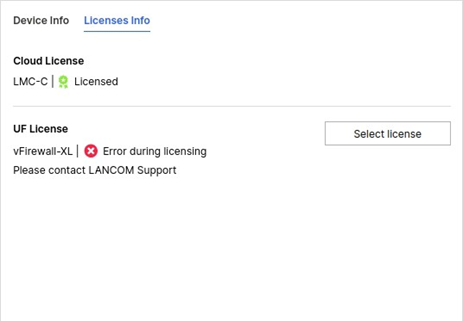
If licensing fails you can also check the system log of the vFirewall. You should find a log entry describing the problem, such as

or

If you have selected a licence that is not large enough, you can return to the licence selection window in the LMC at any time to select a suitable licence.
Changing the size of your vFirewall:
One advantage of using a VM as the host for your vFirewall is the ability to adjust your configuration to match your actual resource requirements. SPLA makes this even easier by offering flexible billing and quick and easy deployment of licence files.
However, if you change your VM's hardware, you must take special care to avoid interruptions due to the limitations mentioned above.
The procedure required depends on whether you want to upgrade (allocate more resources) or downgrade (allocate fewer resources) your VM.
Upgrade: Add more resources
Adding resources to your VM would invalidate the licence due to the size restrictions mentioned at the beginning of this article. After starting the vFirewall with the additional CPU cores or more RAM, the existing licence would be rejected.
Follow these steps to avoid such issues:
- Go to the licence selection screen in the LMC and select a licence that matches the resource layout you want to upgrade the VM to. The first section of this article will help you determine the minimum licence size.
- After the licence has been applied, shut down the vFirewall and adjust the VM settings.
- Then restart the vFirewall. The system should function as usual, but at a faster speed.
Downgrade: Remove additional resources
Removing additional resources is less problematic because your current licence always works with fewer resources than before.
Follow these steps to avoid problems:
- Turn off the vFirewall and reduce the VM's resources as desired.
- Restart the vFirewall.
- Go to the licence selection screen in the LMC and select a smaller licence that is still large enough to meet the requirements specified by the VM configuration.
Examples:
Upgrade: Add additional memory
The vFirewall is currently configured as follows
- Licence - vFirewall-M
- 2 CPU cores
- 8 GB RAM
You want to add another 8 GB of RAM so that a total of 16 GB of RAM is available.
Proceed as follows:
1. On the licence selection screen in the LMC, find the smallest vFirewall variant that meets the requirements of the new resource layout.
- The vFirewall-L licence allows 4 CPU cores and 16 GB RAM
- Since we are still only using 2 CPU cores and are still within the 16 GB RAM limit for a vFirewall-L, we select this size.
2. Therefore, select the vFirewall-L licence.
3. Wait a moment until the selected licence has been applied and then shut down the vFirewall.
4. Now increase the RAM of the VM to 16 GB.
5. Then start the vFirewall.
Downgrade: Removing additional main memory
The vFirewall is currently configured as follows:
- Licence - vFirewall-M
- 2 CPU cores
- 16 GB RAM
It is summertime and employees are on holiday. The vFirewall therefore does not currently require 16 GB RAM. 8 GB RAM is sufficient for a few weeks.
The RAM should therefore be reduced by 8 GB. Proceed as follows:
1. Shut down the vFirewall.
2. Now reduce the RAM of the VM to 8 GB.
3. Then start the vFirewall.
4. Open the license selection screen in the LMC and find the smallest vFirewall variant that meets the requirements of the new resource layout.
In this case, this would be the vFirewall-M licence, as it allows 2 CPU cores and 8 GB RAM. Since only 2 CPU cores are used and the RAM memory has been reduced, the system properties are within the limits for a vFirewall-M.
5. Select the vFirewall-M licence.
Tips and tricks:
It may happen that the licence selection screen in the LMC already displays the values you want to apply (vFirewall size and licence variant) and clicking on these values again does not trigger a licence rollout to your device.
However, if you want to roll out the licence to your device immediately, you must temporarily select a different licence variant (e.g. ‘Basic’ instead of ‘Full’) and then switch back to the desired variant.